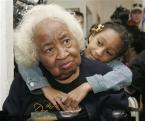
The first person to record Glen Burleigh's gospel classic "Order My Steps", Barbara Johnson Tucker was born June 28, 1949 in Conroe. The song won the 1994 Texas Gospel Music Awards Song of the Year and was nominated for a Dove award the following year.
Mrs. Tucker began her career singing as a child with her mother, brother and sister, and later attended Texas Southern University. In 1969 she appeared in the Broadway play "The Great White Hope" and performed at Carnegie Hall. She sang at the funerals of Mickey Leland and Barbara Jordan. In 2000 she was presented in concert at the Kennedy Center in Washington DC.
The "Galveston Giant" was born on March 31, 1878 and left school in fifth grade to work on the docks and later as a sparring partner. He won his first title in 1903 becoming the World Colored Heavyweight Champion. The current champion, James J Jeffries, refused to fight him, but in 1908 he gained the World Heavyweight Championship over Canadian Tommy Burns. White anger over an African American man holding the title led author Jack London to call for a "Great White Hope" to fight Jackson, and Jeffries came out of retirement for a bout on July 4, 1910 in Reno, Nevada.
Rioting followed Jackson's win, causing films of boxing matches to be banned until 1940 in fear that they would cause further unrest, and former President Theodore Roosevelt -- a boxer himself -- called for a complete ban of the sport. Jackson eventually lost his title to Jess Willard in 1915 after being knocked out in the 26th round of a 45-round fight.
In 1920 he began serving a year-long federal prison sentence for violation of the Mann Act, and afterward fought professionally until 1938 but lost seven on his last nine fights. He died in 1946 of injuries following a car accident in Raleigh, NC.
An influence on Stevie Ray Vaughan and Eric Clapton, the "Texas Cannonball" was born near Gilmer on September 3, 1934. His family moved to Chicago when he was fifteen where he immediately began sneaking into South Side nightclubs listening to such artists as Muddy Waters and Elmore James. He later became a headliner in the newly-emerging blues clubs on the West Side.
King is best known for his aggressive guitar style in instrumentals such as "Hideaway", which led to the release of the album "Freddie King Goes Surfing". He died of heart failure in Dallas on December 28, 1978 at the age of 42.
Clara Luper, mother of the Civil Rights Movement in Oklahoma, passed away yesterday at the age of 88. She marched with Martin Luther King, led sit-ins at the Katz Drugstore in Oklahoma City and was instrumental in forming the Youth Chapter of the Oklahoma City NAACP.
Members of the Paris NAACP were fortunate to hear her speak several years ago at a banquet benefitting the Community Center in Hugo. She vividly described what must have been going through Dred Scott's mind awaiting the U. S. Supreme Court decision that could tell him "You are Somebody" only to hear "You are Nobody", followed by a reminder to the audience each one is, indeed, Somebody.
Featured in The Pursuit of Happyness, Glide Memorial UMC in San Francisco has been served by Rev. Williams for almost 50 years, first as pastor and now as Minister of Liberation since his denominational retirement in 2000.
Rev. Williams was born in San Angelo on September 22, 1929, the same year that construction on Glide Memorial began. He graduated from Huston-Tillotson University with a degree in sociology and from Perkins School of Theology at SMU where he was one of the first five African American graduates.
"The true church stays on the edge of life, where the real moans and groans are. Most church folks settle in, get comfortable and build doctrinal walls to protect themselves from anyone who thinks or looks differently than they do." ~ Rev. Cecil Williams, quoted in PBS series This Far By Faith [a great read about Rev. Williams' call to ministry and his outreach in San Francisco]
Founded in 1872 by the African Methodist Episcopal Church and named after the fourth AME bishop, Paul Quinn College is the oldest historically black liberal arts college in Texas. Originally in Austin, it relocated to Waco in 1877 and then to its current home in Dallas in 1990.
Last year, PQC's unused football field was turned into a community farm in partnership with Pepsico's Food For Good initiative. The college was named HBCU of the Year for 2011 by the Center for HBCU Media Advocacy Inc., and Michael J Sorrell was among the nominees for President of the Year.
I can imagine the cadences of her eloquence echoing at the speed of light past orbiting planets and pulsars, past black holes and white dwarfs and hundreds of millions of sun-like stars, until the whole cosmic spectrum stretching out to the far fringes of space towards the very origins of time resonates to her presence. ~ Bill Moyers
Barbara Jordanwas the first African American elected to the Texas Senate after reconstruction and the first Southern black woman elected to the U.S. House of Representatives. Born in Houston on February 21, 1936, she was a graduate of Texas Southern University in Houston (where the Barbara Jordan Institute For Policy Researchis named in her honor) and the Boston University School of Law, and a member of Delta Sigma Thetasorority.
Ms. Jordan first came into the national spotlight during the Nixon impeachment hearings in 1974, and she later gave the keynote address at the 1976 Democratic National Convention. She passed away on January 17, 1996 after a long battle with Multiple Sclerosis.