LOCAL UNIT INFORMATION and
BLACK HISTORY BLOG FEATURING EVENTS AND PEOPLE CONNECTED TO TEXAS OR NAACP.
SOME DAYS ARE DATE-SPECIFIC, SO CHECK THE BIRTHDAYS!
________________________________________________________________________________________________________________________
"It is certain, in any case, that ignorance, allied with power, is the most ferocious enemy justice can have." ~ James Baldwin
"Nothing in the world is more dangerous than sincere ignorance and conscientious stupidity." ~ Martin Luther King, Jr.
P O Box 1752 Paris TX 75461 ~ 903.783.9232 ~ naacp6213@yahoo.com
Meets First Thursday of Each Month at 6:00 PM ~ 121 E Booth

Thursday, September 8, 2011

Ruby Bridges

Please God, forgive these people because even if they say those mean things they don't know what they're doing. So you can forgive them just like you did those folks along time ago when they said terrible things about you.

Ruby Bridges Hall was born September 8, 1954 near Tylerton, Mississippi and moved to New Orleans with her family when she was four. In 1960 she was one of six African American children chosen to integrate the New Orleans school system and the only one to attend William Frantz Elementary. The first day of court-ordered desegregation was November 14, and U. S. Marshals took her to school. She recalls that day, "Driving up I could see the crowd, but living in New Orleans, I actually thought it was Mardi Gras. There was a large crowd of people outside of the school. They were throwing things and shouting, and that sort of goes on in New Orleans at Mardi Gras."

White parents removed their children from the school, and teachers refused to have Bridges in their classroom. She spent her first-grade year as the only student of Barbara Henry, a newly-hired teacher from Boston. The marshals continued to escort her amid threats, and her mother suggested that she pray on the way to school. Her father lost his job for sending her to the all-white school, although supporters found him another one, and her grandparents in Mississippi were evicted from the farm where they sharecropped.


Norman Rockwell painted "The Problem We All Live With", showing Bridges dressed in white and surrounded by the marshals. The painting has been on loan to the White House from the Norman Rockwell Museum since June. It was also the cover of the January 1964 Look magazine. A White House blog said that Rockwell
" ...was a longtime supporter of the goals of equality and tolerance. In his early career, editorial policies governed the placement of minorities in his illustrations (restricting them to service industry positions only). However, in 1963 Rockwell confronted the issue of prejudice head-on with this, one of his most powerful paintings.”
Bridges is the subject of a children's biography, The Story of Ruby Bridges, by Robert Coles (the child psychologist who counseled her in first grade), a 1998 TV movie, and the song Ruby's Shoes by Lori McKenna. She currently lives in New Orleans and has four grown sons as well as four nieces she raised after their father's death. She worked as a travel agent and is the chair of the Ruby Bridges Foundation which has the slogan "Racism is a grown-up disease and we must stop using our children to spread it."


Wednesday, September 7, 2011

Jacob Lawrence

"My belief is that it is most important for an artist to develop an approach and philosophy about life - if he has developed this philosophy, he does not put paint on canvas, he puts himself on canvas."


Jacob Armstead Lawrence was born September 7, 1917 in Atlantic City, New Jersey. His parents divorced when he was 12 and his mother moved the family to New York City, enrolling him in an arts and crafts center in Harlem to occupy him after school until she got off work.

Wright began taking formal classes at the WPA-funded Harlem Art Workshop and the Harlem Community Art Center in 1932, where director Augusta Savage got him a scholarship to the American Artists School and a paid position with the WPA. It was at the Art Center that he met his wife, artist/sculptor Gwendolyn Knight.

His first exhibit was in Baltimore at the age of 21 with a group of 41 paintings depicting the life of Toussaint L'Ouverture. Later series focused on Frederick Douglass, Harriet Tubman and John Brown. Two years later a collection of 60 paintings on the Great Migration was shown at the New York's prestigious Downtown Gallery. The paintings were bought by the Museum of Modern Art and the Phillips Collection of Washington D. C. Fortune Magazine covered the sale, printing color reproductions of 26 of the paintings and bringing Lawrence's work to the attention of the American public. Thus he became one of the most widely-known African American artist of the twentieth centrury.

With Gwendolyn Knight
Lawrence served in the Coast Guard during World War II, continuing to paint. His work from this time, and later paintings based on his experiences, made up the collection entitled War. Other series were Life In Harlem and Desegregation, with "The Ordeal of Alice" being the most well-known of the latter group. After the Desegregation series he focused on the theme of collaboration in The Builders, with one of the series being bought by the White House Historical Association in 2007 for $2.5 million. It currently hangs in the Green Room.

Lawrence taught at the Pratt Institute and at other schools in the New York area. In 1970 he and Knight moved to Seattle where he was on the faculty of the University of Washington. He was awarded the NAACP's Spingarn Medal the same year, and in 1983 was elected to the American Academy of Arts and Letters.

He died in Seattle on June 9, 2000 at the age of 82. The Jacob and Gwendolyn Knight Lawrence Foundation administers their estates and archives their work. Knight died in 2005. The Seattle Art Museum gives an annual $10,000 award in their names to artists who "reflect the cultural contexts and values systems that informed their work."

"Our homes were very decorative, full of pattern, like inexpensive throw rugs. It must have had some influence, all this color and everything. Because we were so poor the people used this as a means of brightening their life. I used to do bright patterns after these throw rugs; I got ideas from them, the arabesques, the movement and so on."

The Seamstress

Tombstones

The Builders

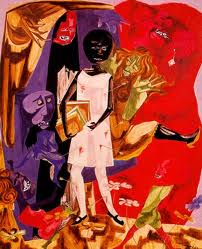
The Ordeal of Alice

Self-Portrait

Scaffold

Migration 17

Daybreak

Migration 3

Tuesday, September 6, 2011

Joel Augustus Rogers

"Ethiopians, that is, Negroes, gave the world the first idea of right and wrong and thus laid the basis of religion and all true culture and civilization."

Historian and journalist Joel Augustus Rogers was born September 6, 1883 in Negril, Jamaica and emigrated to the United States in 1906 after having served in the British Army. He settled in Harlem and became part of the Harlem Renaissance, befriending such intellectuals as Hubert Harrison.

Self-taught in sociology, anthopology and history, Rogers used the social sciences to refute the pervasive racism of the era. His first book, From "Superman" to Man, takes the form of a series of dialogues between a Pullman porter and a Southern politician. It addresses themes such as innate intelligence, intermarriage and world contributions that are expanded in his later works.

Rogers was a reporter for several African American publications including the Pittsburgh Courier and the Chicago Enterprise. He knew Marcus Garvey from Jamaica and covered Garvey's 1923 trial. He also reported on the coronation of Ethiopian Emperor Haile Selassie in 1930 for the Amsterdam News and later that decade covered the invasion of that country by Italian forces, becoming the first African American war correspondent. In 1934 Rogers began a feature series similar in format to Ripley's Believe it or Not entitled Your History to present information from his research. It ran in African American periodicals until 1971 under several titles, including Facts about the Negro. Excerpts were published in the book 100 Amazing Facts About the Negro


Rogers wrote histories of the Ku Klux Klan, Ethiopia, and the Caribbean, and learned French, German, Italian and Spanish in order to conduct research through Europe, writing about the African ancestry of such Europeans as Alexander Pushkin and Alexandre Dumas in World's Great Men of Color (1946). He presented the African contribution in the United States in Africa's Gift to America: The Afro-American in the Making and Saving of the United States (1959). He wrote a total of 16 books, mostly self-published.

Rogers died March 26, 1966 in New York City at the age of 85. Because of his lack of academic credentials he is not well known as a historian but was highly regarded by professionals in the field and other African American intellectuals.
"No man living has revealed so many important facts about the Negro race as has Rogers." ~ W. E. B. DuBois 
 "[Rogers] looked at the history of people of African origin, and showed how their history is an inseparable part of the history of mankind." ~ John Henrik Clarke

Monday, September 5, 2011

Larry Neal


"...On the road:
It would be some hoodoo town
It would be some cracker place
you might meet redneck lynchers
face to face
but mostly you meet mean horn blowers
running obscene riffs..."


(from "Don't Say Goodbye to the Porkpie Hat")


Lawrence Paul Neal was born September 5, 1937 in Atlanta. When he was a small child his family moved to Philadelphia, where he graduated from Lincoln University in 1961 with a double major in English and History. He then earned a master's degree from the University of Pennsylvania and taught briefly at Drexel before moving to New York City.

Neal became arts editor of the black nationalist magazine The Liberator, where he reviewed African American events and became a leading voice of the Black Arts Movement which he described in a 1968 essay as being
...radically opposed to any concept of the artist that alienates him from his community. Black Art is the aesthetic and spiritual sister of the Black Power concept. As such, it envisions an art that speaks directly to the needs and aspirations of Black America....The Black Arts and the Black Power concept both relate broadly to the Afro-American’s desire for self-determination and nationhood. Both concepts are nationalistic. One is politics; the other with the art of politics.
Recently, these two movements have begun to merge: the political values inerent in the Black Power concept are now finding concrete expression in the aesthetics of Afro-American dramatists, poets, choreographers, musicians, and novelists. A main tenet of Black Power is the necessity for Black people to define the world in their own terms. The Black artist has made the same point in the context of aesthetics. The two movements postulate that there are in fact and in spirit two Americas—one black, one white.... 
Neal collaborated with Amiri Baraka editing Black Fire: An Anthology of Afro-American Writing, published in 1968. The two had worked together earlier founding the Black Arts Repertory Theater and School, staging plays and poetry readings on the streets of Harlem. Although it folded after three months, it became a model for similar efforts around the country.


In addition to numerous essays in both arts periodicals and general publications such as Partisan Review, The New York Times and Ebony, Neal wrote two plays, The Glorious Monster In the Bell of the Horn (1979) and In an Upstate Motel  (1981). His poetry appeared in two volumes, Black Boogaloo (1969) which addressed the African roots of the Black Arts Movement, and Hoodoo Hollerin Bebop Ghosts (1971) concentrating on the experience of the American South.


Neal continued to teach as well as write. At various times he was on the faculties of the City University of New York and of Wesleyan College in Middletown, Connecticut, and held a chair in humanities at Howard University. From 1970 to 1975 he taught at Yale; during this time he was the recipient of a Guggenheim Fellowship.  In 1975 he became executive director of the Washington D.C. Commission on the Arts and Humanities.


Neal died of a sudden heart attack on January 6, 1981 while leading a theater workshop at Colgate University. He was 43 years old. At the time of his death he was working with drummer Max Roach on Roach's autobiography, writing the introduction for a three-volume set of the works of Zora Neale Hurston, and compiling a series on jazz for the Boston PBS television station WGBH. A partially completed manuscript on the rise of the Black Arts Movement and black consciousness, Visions of a Liberated Future, was completed by his widow and published in 1989.


Poppa Stoppa Speaks From His Grave

Remember me baby in my best light,
lovely hip style and all;
all laid out in my green velour
stashing on corners
in my boxcar coat--
so sure of myself, too cool for words
and running down a beautiful game.
It would be super righteous
if you would think of me that way sometimes;
and since it can't be that way,
just the thought of you digging me that way
would be hip and lovely even from here.
Yeah, you got a sweet body, baby,
but out this way, I won't be needing it;
but remember and think of me
that way sometimes.
But don't make it no big thing though;
don't jump jive and blow your real romance.
but in a word, while you high-steppin and finger-popping
tell your lovin man that I was a bad
motherfucker till the Butcher cut me down.

Sunday, September 4, 2011

Richard Wright

 "I was leaving the South 
to fling myself into the unknown . . . 
I was taking a part of the South 
to transplant in alien soil, 
to see if it could grow differently, 
if it could drink of new and cool rains, 
bend in strange winds, 
respond to the warmth of other suns
and, perhaps, to bloom"

Richard Nathaniel Wright was born September 4, 1908 near Natchez, Mississippi. His family moved around throughout the area, often living with relatives after his father left and his mother suffered a series of strokes. Wright, his mother and older brother settled in Jackson, Mississippi when he was eight to live with his grandmother, an extremely religious woman. The repression he experienced there, as well as the racism encountered in daily life, formed the basis for his writing throughout his life.

Wright graduated from Junior High as valedictorian but refused to give a speech written by the vice principal that catered to the all-white school board. This was the end of his formal education, and at age 15 he moved to Memphis where he began reading H. L. Mencken and other books a white co-worker checked out of the library for him. He later moved to Chicago, continuing to educate himself, reading the naturalist literature of Theodore Dreiser, Sherwood Anderson, and Sinclair Lewis. He worked as a postal clerk, and his mother, brother and aunt came to live with him. When he was laid off in 1931 the family was forced to go on relief.

During this time Wright joined the John Reed Club, a Marxist organization for artists, writers, and other intellectuals. He joined the Communist Party in 1933 but became disenchanted by power struggles and racism in the part, as well as being perceived as bourgeois by other African Americans because of his intellect and his association with whites.  His experience during this time was published in 1944 in Atlantic Monthly as "I Tried to Be a Communist".

Wright moved to New York in 1937 where he became the Harlem editor of The Daily Worker, and participated in a WPA writers' project where he won a $500 prize for his short story, Fire and Cloud. The acclaim from this win led to the publication of a collection of four novellas, Uncle Tom's Children, a brutal depiction of life in the South.

It was followed in 1940 by Wright's most noted work, Native Son, again a bleak portrayal of African American life in the early part of the twentieth century. This book, set in Chicago, explores the  social forces leading central character Bigger Thomas to murder his employer's daughter. An immediate best-seller, it became the first Book of the Month Club selection written by an African American and is considered one of the most influential books of the century.

A dramatic version written by Wright and Paul Green, and produced by Orson Welles, opened on Broadway the following year. Also in 1941 Twelve Million Black Voices was published, with Wright's descriptions of photographs by Edwin Rosskan. An autobiography Black Boy came out in 1945, depicting Wright's life in the South before his move to Chicago. A second volume covering his later years, American Hunger, was published posthumously in 1977.

To escape American racism and the growing anti-Communist political climate, Wright moved to Paris in 1946, becoming a French citizen the next year. His later novels, influenced by his association with existentialists Jean-Paul Sartre, Albert Camus, and Simone de Beauvoir, did not have the success of his earlier work. He traveled throughout Europe, Africa and Asia, writing non-fiction accounts of culture, politics and religion. He began writing haiku in the late 1950's, amassing over four thousand, with 817 published in Haiku: This Other World  in 1997.

Keep straight down this block,
then turn right where you will find
a peach tree blooming.


As the sun goes down, 
a green melon splits open
and juice trickles out 

Coming from the woods,
a bull has a lilac sprig
dangling from a horn


The Christmas season:
a whore is painting her lips
larger than they are  

Wright died suddenly in Paris of a heart attack on November 28, 1960 at the age of 52. He was the recipient of a Guggenheim Fellowship in 1939 and the NAACP Spingarn Medal in 1941.


I Have Seen Black Hands

I am black and I have seen black hands, millions and millions of them --
Out of millions of bundles of wool and flannel tiny black fingers have reached restlessly and hungrily for life.
Reached out for the black nipples of black breasts of black mothers,
And they've held red, green, blue, yellow, orange, white, and purple toys in the childish grips of possession,
And choclate drops, peppermint sticks, lollypops, wineballs, ice cream cones, and sugared cookies in fingers sticky and gummy,
And they've held balls and bats and gloves and marbles and jack-knives and slingshots and spinning tops in the thrill of sport and play,
And pennies and nickels and dimes and quarters and sometimes on New Year's, Easter, Lincoln's Birthday, May Day, a brand new green dollar bill,
They've held pens and rulers and maps and books in palms spotted and smeared with ink,
And they've held dice and cards and half-pint flasks and cue sticks and cigars and cigarettes in the pride of new maturity . . .
II
I am black and I have seen black hands, millions and millions of them --
They were tired and awkward and calloused and grimy and covered with hangnails,
And they were caught in the fast-moving belts of machines and snagged and smashed and crushed,
And they jerked up and down at the throbbing machines massing taller and taller the heaps of gold in the banks of the bosses,
And they piled higher and higher the steel, iron, the lumber, wheat, rye, the oats, corn, the cotton, the wool, the oil, the coat, the meat, the fruit, the glass, and the stone until there was too much to be used,
And they grabbed guns and slung them on their shoulders and marched and groped in trenches and fought and killed and conquered nations who were customers for the goods black hands made.
And again black hands stacked goods higher and higher until there was too much to be used,
And then the black hand held trembling at the factory gates the dreaded lay-off slip,
And the black hands hung idle and swung empty and grew soft and got weak and bony from unemployment and starvation,
And they grew nervous and sweaty, and opened and shut in anguish and doubt and hesitation and irresolution . . .
III
I am black and I have seen black hands, millions and millions of them --
Reaching hesitantly out of days of slow death for the goods they had made, but the bosses warned that the goods were private and did not belong to them,
And the black hands struck desperately out in defense of life and there was blood, but the enraged bosses decreed that this too was wrong,
And the black hands felt the cold steel bars of the prison they had made, in despair tested their strength and found that they could neither bend nor break them,
And the black hands fought and scratched and held back but a thousand white hands took them and tied them,
And the black hands lifted palms in mute and futile supplication to the sodden faces of mobs wild in the reveries of sadism,
And the black hands strained and clawed and struggled in vain at the noose that tightened about the black throat,
And the black hands waved and beat fearfully at the tall flames that cooked and charred the black flesh . . .
IV
I am black and I have seen black hands
Raised in fists of revolt, side by side with the white fists of white workers,
And some day -- and it is only this which sutains me --
Someday there shall be millions and millions of them,
On some red day in a burst of fists on a new horizon!


"Between the World and Me"


And one morning while in the woods I stumbled
    suddenly upon the thing,
Stumbled upon it in a grassy clearing guarded by scaly
    oaks and elms
And the sooty details of the scene rose, thrusting
    themselves between the world and me....
There was a design of white bones slumbering forgottenly
    upon a cushion of ashes.
There was a charred stump of a sapling pointing a blunt
    finger accusingly at the sky.
There were torn tree limbs, tiny veins of burnt leaves, and
    a scorched coil of greasy hemp;
A vacant shoe, an empty tie, a ripped shirt, a lonely hat,
    and a pair of trousers stiff with black blood.
And upon the trampled grass were buttons, dead matches,
    butt-ends of cigars and cigarettes, peanut shells, a
    drained gin-flask, and a whore's lipstick;
Scattered traces of tar, restless arrays of feathers, and the
    lingering smell of gasoline.
And through the morning air the sun poured yellow
    surprise into the eye sockets of the stony skull....
And while I stood my mind was frozen within cold pity
    for the life that was gone.
The ground gripped my feet and my heart was circled by
    icy walls of fear--
The sun died in the sky; a night wind muttered in the
    grass and fumbled the leaves in the trees; the woods
    poured forth the hungry yelping of hounds; the
    darkness screamed with thirsty voices; and the witnesses rose and lived:
The dry bones stirred, rattled, lifted, melting themselves
    into my bones.
The grey ashes formed flesh firm and black, entering into
    my flesh.
The gin-flask passed from mouth to mouth, cigars and
    cigarettes glowed, the whore smeared lipstick red
    upon her lips,
And a thousand faces swirled around me, clamoring that
    my life be burned....
And then they had me, stripped me, battering my teeth
    into my throat till I swallowed my own blood.
My voice was drowned in the roar of their voices, and my
    black wet body slipped and rolled in their hands as
    they bound me to the sapling.
And my skin clung to the bubbling hot tar, falling from
    me in limp patches.
And the down and quills of the white feathers sank into
    my raw flesh, and I moaned in my agony.
Then my blood was cooled mercifully, cooled by a
    baptism of gasoline.
And in a blaze of red I leaped to the sky as pain rose like water, boiling my limbs
Panting, begging I clutched childlike, clutched to the hot
    sides of death.
Now I am dry bones and my face a stony skull staring in
    yellow surprise at the sun....


Saturday, September 3, 2011

Charles H Houston

"From the start, it was evident that [Houston] had a mind ideally contoured for a career at law. He relished the kind of abstract thinking needed to shape the building blocks of the law. He had a clarity of thought and grace of phraseology, a retentive brain, a doggedness for research, and a drive within him that few of his colleagues could match or understand." ~ Richard Kluger, Simple Justice


Charles Hamilton Houston was born September 3, 1895 in Washington, D.C. His father was an attorney, later serving as Assistant U. S. Attorney General, and his mother had taught school before their marriage. Houston attended M Street High School (now Paul L. Dunbar High), one of the few academic high schools for African Americans at the time. He won a scholarship to Amherst College in Massachusetts where he was elected to Phi Beta Kappa and graduated Magna Cum Laude as valedictorian in 1915. He returned to Washington and taught English composition and literature at Howard University until the outbreak of World War I.

Houston enlisted in the Army and applied for Officer's Candidate School. He served as a First Lieutenant in the Infantry in France, and the unequal treatment of African American soldiers he witnessed and experienced there shaped his future as an attorney. In Richard Kluger's biography of Houston, Simple Justice, he is quoted as saying, “I made up my mind that I would never get caught again without knowing my rights; that if luck was with me, and I got through this war, I would study law and use my time fighting for men who could not strike back.”

Houston returned to the states in February of 1919, and events of that year's Red Summer of riots also influenced him as his father -- who usually worked in civil law -- took the case of Theodore Micajah Walker, who was accused of murder while defending himself. Walker was found guilty by an all-white jury.

In the fall, Houston was accepted at Harvard Law School. He was the first African American to serve on the Law Review, and graduated in the top 5% of his class in 1922. He stayed on at Harvard to earn a doctorate in Juridical Science under Felix Frankfurter, and spent another year at the University of Madrid where he was granted a doctorate in Civil Law.

Houston then joined his father's law firm and began teaching part-time at the Howard Law School. He became an Associate Professor in 1929, and Dean of the Law School in 1932. He raised the academic standards and improved the library and curriculum, setting high standards for students and training them in civil rights law. Said student Thurgood Marshall,
"He used to tell us that doctors could bury their mistakes but lawyers couldn't. And he'd drive home to us that we would be competing not only with white lawyers but really well-trained white lawyers, so there just wasn't any point crying in our beer about being Negroes. … He made it clear to all of us that when we were done, we were expected to go out and do something with our lives."
Recruited as the NAACP's first full-time paid legal counsel in 1935, Houston systematically chose a succession of cases to challenge the constitutionality of the "separate but equal" basis of Plessy v Ferguson. Many involved education, and others addressed union membership, restrictive clauses in real estate sales, and hiring practices. Dating back to his days at Howard Law School, there were few civil rights cases that were heard by the U. S. Supreme Court that Houston was not involved in, and these cases laid the groundwork for the landmark Brown decision in 1954.

Houston died of a heart attack on April 22, 1950 in Washington, and received the NAACP's Spingarn Medal posthumously that year. As his protege Thurgood Marshall rose to prominence his contribution to justice for African Americans became more widely known. The Charles Hamilton Houston Institute For Race and Justice at Harvard is named in his honor, as is Charles Hamilton Houston Hall, the main building at the Howard Law School. He was a member of Alpha Phi Alpha fraternity.

Friday, September 2, 2011

Romare Bearden

"What I saw was black life, presented on its own terms, on a grand and epic scale, with all its richness and fullness, in a language that was vibrant and which, made attendant to everyday life, ennobled it, affirmed its value, and exalted its presence… It defined not only the character of black American life, but also its conscience." ~ August Wilson on Romare Bearden

Romare Bearden was born on September 2, 1911 in Charlotte, North Carolina, and his family moved to Harlem three years later. His mother was New York editor for the Chicago Defender, a position which introduced her to leading figures of the Harlem Renaissance. Bearden spent summers in North Carolina and graduated from Peabody High School in Pittsburgh while living with his grandparents.

He then attended New York University, graduating in 1935 with a degree in education. He began his art career during college with cartoons published in the campus magazine and national publications such as Colliers and The Saturday Evening Post. After graduation he studied at the art Students League under George Grosz, primarily painting scenes of the American south. He also began working for the New York City Department of Social Services as a caseworker for the gypsy population, a position he held until 1969.

Morning
After serving in Europe with the U. S. Army during World War II, Bearden returned to Europe to study at the Sorbonne in Paris where his work was strongly influenced by Picasso and Matisse. Critic Hilton Kramer referred to his style as "patchwork cubism". It also encompasses global artforms such as Mexican murals, African masks and textures, Japanese prints and Chinese landscapes, while emphasizing social realism and Bearden's personal experience.

Although working in a variety of mediums he is best know for his collages, one of which was on the cover of Time in 1968, and Encyclopedia Britannica refers to him as "the preeminent collagist in the U.S." Many of his public murals are based on his collages, such as the 10' by 16' Berkeley - The City and Its People in the Berkeley, California, City Hall, and Pittsburgh Recollections at the Gateway subway station in Pittsburgh, which is valued at $15 million. Bearden also did book illustrations and set designs for the Alvin Ailey Dance Company in Harlem. He wrote three books on African American art, and published numerous essays and reviews. In the early 1950's he was a songwriter, with his Sea Breeze being recorded by Billy Eckstine and Dizzy Gillespie. In 2003 Branford Marsalis recorded a CD of his songs. There is much musical imagery in Bearden's work, and his Harlem studio was above the Apollo Theater.

Bearden died in New York City on March 12, 1988 at the age of 76. The Romare Bearden Foundation was established two years later to preserve his legacy and to support young artists.
"I think the artist has to be something like a whale, swimming with his mouth wide open, absorbing everything until he has what he really needs. When he finds that, he can start to make limitations. And then he really begins to grow." ~ Romare Bearden