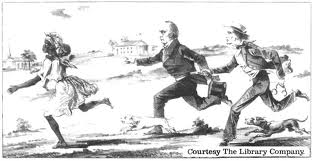
"I hear a good deal said about trampling this law under foot. Why, one need not go out of his way to do that. This law rises not to the level of the head or the reason; its natural habitat is in the dirt. It was born and bred, and has its life, only in the dust and mire, on a level with the feet; and he who walks with freedom, and does not with Hindoo mercy avoid treading on every venomous reptile, will inevitably tread on it, and so trample it under foot,—and Webster, its maker, with it, like the dirt-bug and its ball." ~ Henry David Thoreau
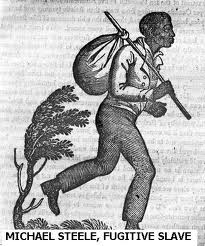
The Fugitive Slave Act was passed September 18, 1850 as part of the 1850 Compromise between Southern slave states and Northern free states. It required states to returned escaped slaves to their owners with marshals receiving a bonus for capturing slaves and being fined $1000 if they did not arrest an alleged escapee. Private citizens were fined the same amount for providing food, shelter, or transportation to runaways. An owner could claim a slave had fled by signing an affidavit, and no jury trials were held. As a result, many free blacks were arrested and sold into slavery. Between the time the act was passed and the beginning of the Civil War, an estimated 20,000 blacks fled to Canada.
Abolitionists increased their efforts with the passage of the act, and many citizens who had previously been neutral on the issue of slavery began to oppose it because the act made all residents and elected officials responsible for enforcement. Further adding to the opposition was the publication in 1852 of Harriet Beecher Stowe's Uncle Tom's Cabin.
In November 1850 Vermont passed the "Habeus Corpus Law" requiring state officials to aid escaped slaves, thus nullifying the Fugitive Slave Act in that state. The Wisconsin Supreme Court declared the act unconstitutional in 1854, although this decision was overturned five years later. Jury nullification in other states led to those being accused of helping runaways being found not guilty, most notably a case involving the rescue of Shadrach Menkins in Boston in 1851 prosecuted by Daniel Webster.
Although part of a compromise designed to appease both sides, the act solidified the North in opposition to slavery and the demands of the South. Thus, it became one of the major causes that led to secession and the Civil War.
LOCAL UNIT INFORMATION and
BLACK HISTORY BLOG FEATURING EVENTS AND PEOPLE CONNECTED TO TEXAS OR NAACP.
SOME DAYS ARE DATE-SPECIFIC, SO CHECK THE BIRTHDAYS!
________________________________________________________________________________________________________________________
"It is certain, in any case, that ignorance, allied with power, is the most ferocious enemy justice can have." ~ James Baldwin
"Nothing in the world is more dangerous than sincere ignorance and conscientious stupidity." ~ Martin Luther King, Jr.
P O Box 1752 Paris TX 75461 ~ 903.783.9232 ~ naacp6213@yahoo.com
Meets First Thursday of Each Month at 6:00 PM ~ 121 E Booth
Showing posts with label Civil War. Show all posts
Sunday, September 18, 2011
Thursday, July 21, 2011
Sgt. Major Christian A. Fleetwood
"Johnny Reb woke us with a few shells. Got his answer and left. Green wounded." ~ Diary Entry, June 10, 1864, Christian Fleetwood
Christian Abraham Fleetwood was born on July 21, 1840 in Baltimore and graduated from Ashman Institute (now Lincoln University) in Oxford, Pennsylvania in 1863 after spending time in Liberia and Sierra Leone.
He enlisted in the U.S. Colored Infantry in 1863 with the rank of sergeant due to his education, and was promoted to sergeant major three days later. He saw action in North Carolina and Virginia, and was awarded the Congressional Medal of Honor for bravery at the Battle of Chaffin's Farm on September 29, 1864 near Richmond. Of the nearly 200,000 African American men who served in the Union forces, he was one of 25 receiving this medal.
Fleetwood kept a pocket diary with daily entries during the year 1864. It can be seen at the Library of Congress website. His Medal of Honor is on display at the Smithsonian's National Museum of American History.
After the war, officers in his regiment petitioned for Fleetwood to receive a commission, which Secretary of War Edwin Stanton declined. Fleetwood worked for two years in Ohio before returning to Washington DC to work for the Freedmen's Bank and the War Department. He helped to organize a National Guard battalion for the area, and was appointed its commanding officer in 1887 with the rank of major. Along with Major Charles B Fisher he also formed the DC Colored High School Cadet Corps and served as its first instructor.
Although deafened during his Army service, Fleetwood was choirmaster of four Washington churches. He died on September 28, 1914 at the age of 74.
Subscribe to:
Posts (Atom)